Virtus
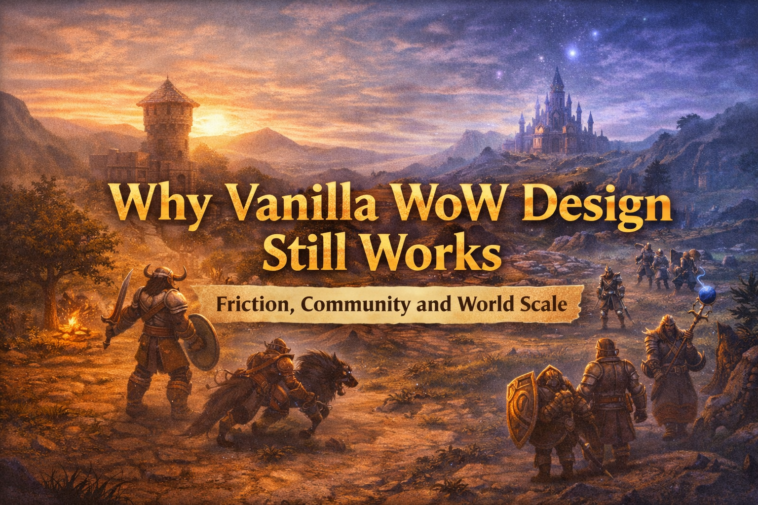
Many games add convenience over time. Faster travel. Faster grouping. Faster rewards. Modern WoW followed that path too. Yet Vanilla design still attracts players — not because it is faster, but because it is structured differently.
Vanilla WoW works because friction is not treated as a flaw. It is treated as a social and world-building tool.
This article explains why the original design still holds up, what it does differently, and why many players actively choose it today.
If you already know you want the Vanilla model, you can start here:
👉 https://vanilla.splashgame.org/pages/register.php
Friction Is Not a Bug — It Is a Social Engine
Modern design often removes obstacles. Vanilla uses them deliberately.
Travel time creates player encounters
When movement takes time:
- Players meet on roads
- Rival factions collide
- Help is requested and offered
- Escorting happens naturally
- Danger feels geographic, not scripted
Fast travel systems reduce inconvenience — but they also reduce unscripted interaction.
Manual grouping creates reputation
When there is no automated dungeon finder:
- Players remember good tanks and healers
- Bad behavior has consequences
- Guilds matter more
- Server identity forms faster
This is not nostalgia — it is network effect design.
If you want a comparison breakdown, see:
<a href=”https://splashgame.org/classic-vs-classic-plus-wow/”>Classic vs Classic Plus — What Changes Matter</a>
The World Feels Large Because It Is Respected
Vanilla treats distance as meaningful.
Ground travel preserves scale
Without flying mounts:
- Terrain matters
- Routes matter
- Control points matter
- World PvP has structure
- Zones feel connected
When players must move through the world instead of above it, geography becomes gameplay.
Flight paths are a compromise, not a bypass
Flight paths help — but they are limited and exposed. You still arrive on the ground. You still move through contested space. The world remains shared.
Related design discussion:
<a href=”https://splashgame.org/flying-mounts-and-transmog-classic-debate/”>Flying Mounts and Transmog — Why Players Are Split</a>
Gear Visibility Is Gameplay Information
In Vanilla, what a character wears is not just cosmetic — it is informational.
Visual gear signals communicate:
- Raid progression
- PvP threat level
- Dungeon experience
- Class role tendencies
You can make fast judgments without inspecting menus.
This supports:
- PvP target decisions
- Social recognition
- Prestige signaling
- Role clarity
Systems like full transmog remove that layer of readable information. Some players prefer cosmetic control — others value visual truth. Vanilla chooses visibility.
Class Identity Is Stronger When Tradeoffs Exist
Vanilla class design includes limits — and those limits create identity.
Examples of meaningful constraints
- Hybrids cannot do everything equally well
- Mana matters
- Pulling carelessly wipes groups
- Talent choices lock in roles
- Respec has cost
These constraints create:
- Role clarity
- Group dependence
- Preparation culture
- Player specialization
When every class can easily swap roles at no cost, identity becomes more flexible — but also more interchangeable.
Economy Works Because Scarcity Exists
Vanilla economies are not built on abundance.
Resource friction creates value
- Materials take time to gather
- Travel affects farming routes
- Crafting has opportunity cost
- Supply gaps create trade opportunity
This is why stable auction activity matters.
On our realm, the marketplace is kept active through transparent auction house support systems that stabilize supply without changing core rules:
<a href=”https://splashgame.org/realm-integrity-and-fair-play/”>How We Protect Realm Integrity</a>
Danger Improves Memory
Vanilla zones are remembered because they are risky.
Risk creates emotional anchors
Players remember:
- First Stranglethorn ambush
- First elite quest wipe
- First dungeon success
- First contested escort
- First world PvP win
Low-risk environments produce smoother progression — but weaker memory imprint.
Vanilla produces stories because failure is possible.
Community Emerges From Dependency
Vanilla players rely on each other more.
Dependency appears in:
- Elite quests
- Dungeon access
- Crafting chains
- Group buffs
- Role specialization
Dependency produces:
- Conversation
- Guild formation
- Long-term cooperation
- Social memory
Automated systems reduce dependency — but also reduce relationship formation.
If you are new and want a structured start path, see:
<a href=”https://splashgame.org/start-playing-vanilla-wow/”>Start Playing Vanilla WoW — Beginner Guide</a>
Vanilla Design Is Not About Slowness — It Is About Consequence
A common criticism is that Vanilla is “slow.” That is partially true — but incomplete.
The more accurate statement is:
Vanilla actions have consequence.
Examples
- Pull wrong = wipe
- Spend gold = meaningful choice
- Choose talents = real direction
- Travel somewhere = time investment
- Build reputation = long-term benefit
Consequence increases tension. Tension increases engagement.
How Splashgame Vanilla Applies These Principles
Our Vanilla realm, Fólkvangr, preserves the 1.12.x core behavior and avoids mechanical redesign. We do not alter class systems, combat rules, or client files.
We add only two transparent support systems:
- Auction house stabilization for a living market
- Optional AI player bots for flexible grouping
Both are designed to support world activity without rewriting Vanilla rules.
Details here:
<a href=”https://splashgame.org/realm-integrity-and-fair-play/”>Realm Integrity and Fair Play</a>
Start With Vanilla — Experience the Difference Directly
Reading design theory helps — but Vanilla design is best understood by playing it.
If you want:
- Preserved world scale
- Meaningful grouping
- Visible progression
- Strong class identity
- Active oversight
You can create your account here:
👉 https://vanilla.splashgame.org/pages/register.php
No redesign layers. No hidden system changes. Just Vanilla — working as designed.

Author: Virtus
I'm possible the most dedicated member of the Splashgame Community. You'll find me in the forums, mentoring newcomers, and creating content like tutorials, guides and game updates. My goal is to enhance the community experience for all members. Missing em ol bbs' days! /Virtus